
Why Is Hot Water Shortage Worse in Summer? A Troubleshooting Guide for Treasure Coast Homeowners
You step into the shower on a humid July morning, and the water turns lukewarm before you’ve rinsed the shampoo out. It’s not the first time this week. If you’re a Treasure Coast homeowner dealing with inconsistent or insufficient hot water during the summer months, you’re not alone, and the problem is rarely what you think it is. Unlike a winter cold snap that might expose a truly broken water heater, summer hot water shortages usually stem from demand overwhelm, thermostat drift, or hidden sediment that your system can’t overcome during peak usage periods.
Water heater technicians across South Florida report a predictable pattern: service calls for hot water issues spike each June and July, driven by the demand dynamics outlined below. The good news is that most summer shortages are fixable without replacing the unit.
This guide walks you through the most common causes of why hot water shortage gets worse in summer, what you can check yourself, and when professional service is the right move. The troubleshooting path is straightforward, and fixing it often doesn’t require a replacement.
Why Summer Increases Household Hot Water Demand
Summer doesn’t just mean warmer weather, it means your water heater works harder in ways that winter rarely demands. Consider the Rodriguez family, a household of four in Jupiter with two teenagers who shower back-to-back each morning before school, followed by a parent rinsing off after a workout, and then a guest arrives mid-week. That’s five to six hot showers drawing from the same tank within a compressed timeframe. Add in extra loads of laundry, more frequent dishwashing because of weekend entertaining, and kids home from school with different routines than the school-year schedule, and your water heater faces a sustained demand curve it wasn’t designed to handle continuously.
The recovery time between uses becomes the critical variable. A 50-gallon tank that recovered adequately between showers in February, when fewer people were home and water usage was spread out, now faces back-to-back draws before the heating element or burner can bring fresh cold water up to temperature. The unit isn’t broken; it’s being asked to meet a temporary load it can technically handle, but not without delays.
Incoming groundwater in Florida is also warmer during summer months, which changes how the heater cycles. However, this actually provides a small advantage: the system doesn’t have to heat water from as cold a baseline. Despite this minor benefit, the sheer volume of simultaneous usage still strains recovery time, leaving the third or fourth person in a shower rotation waiting for hot water or settling for tepid flow.
How to Check and Safely Adjust Your Water Heater Thermostat
Many water heaters arrive from the manufacturer with the thermostat set lower than the ideal temperature, or the setting drifts over time due to vibration or accidental nudging. The recommended safe range for household hot water is between 120°F and 140°F. At 120°F, you balance energy efficiency and safety; at 140°F, you get faster recovery and fuller heat output, though you increase the scalding risk for children and elderly household members if they touch the tap directly.
Here’s how to check and adjust your thermostat safely:
- Turn off power to the unit. For electric water heaters, switch off the breaker. For gas units, turn the control knob to the pilot position.
- Locate the thermostat adjustment panel. On most units, this is a dial or screw hidden behind a removable access cover on the side of the tank. You may need a flathead screwdriver to remove the cover.
- Check the current setting. Note where the dial currently sits relative to the temperature markings.
- Adjust incrementally. If you’re increasing the temperature, move the dial a small amount, roughly 5 to 10 degrees, rather than making a large jump. Overshooting leads to wasted energy or scalding risk.
- Restore power and wait. Turn the breaker or control valve back on and allow the heater to run for at least one hour before testing water temperature.
- Test with a thermometer. Don’t guess by hand. Run hot water at a tap farthest from the heater, hold a cooking or bath thermometer under the flow for 30 seconds, and note the temperature. Adjust again if needed.
Important note for electric units with two heating elements: Both thermostats (upper and lower) should be set to the same temperature. If one is significantly lower than the other, you’ll get uneven heating and reduced efficiency. Check and adjust both before concluding that thermostat adjustment alone is the fix.
If you’ve adjusted the thermostat and waited, but hot water still doesn’t arrive in the expected volume or temperature, the issue likely isn’t a simple setting drift. Move to the next troubleshooting step.
Sediment Buildup as a Hidden Hot Water Thief
Over time, minerals in hard water, primarily calcium and magnesium, settle at the bottom of the tank and form a layer of sediment. This buildup acts as an insulator between the heating element (or gas burner) and the water itself, meaning the unit burns energy but the water never quite reaches the set temperature. In summer, when demand is highest, the impact becomes noticeable: you might hear popping or rumbling sounds during heating cycles, notice longer recovery times between showers, or observe that water temperature plateaus below what the thermostat is set to deliver.
Sediment accumulation is especially aggressive in Florida homes due to the region’s naturally hard water. Field technicians working on the Treasure Coast routinely observe that a single year without flushing can reduce heating efficiency by 15 to 20 percent, compounding the summer demand problem. If your home draws from a well or has hard water entering from the municipal supply, annual or biennial flushing is preventive maintenance that most homeowners skip, and then wonder why their water heater seems to lose efficiency every year.
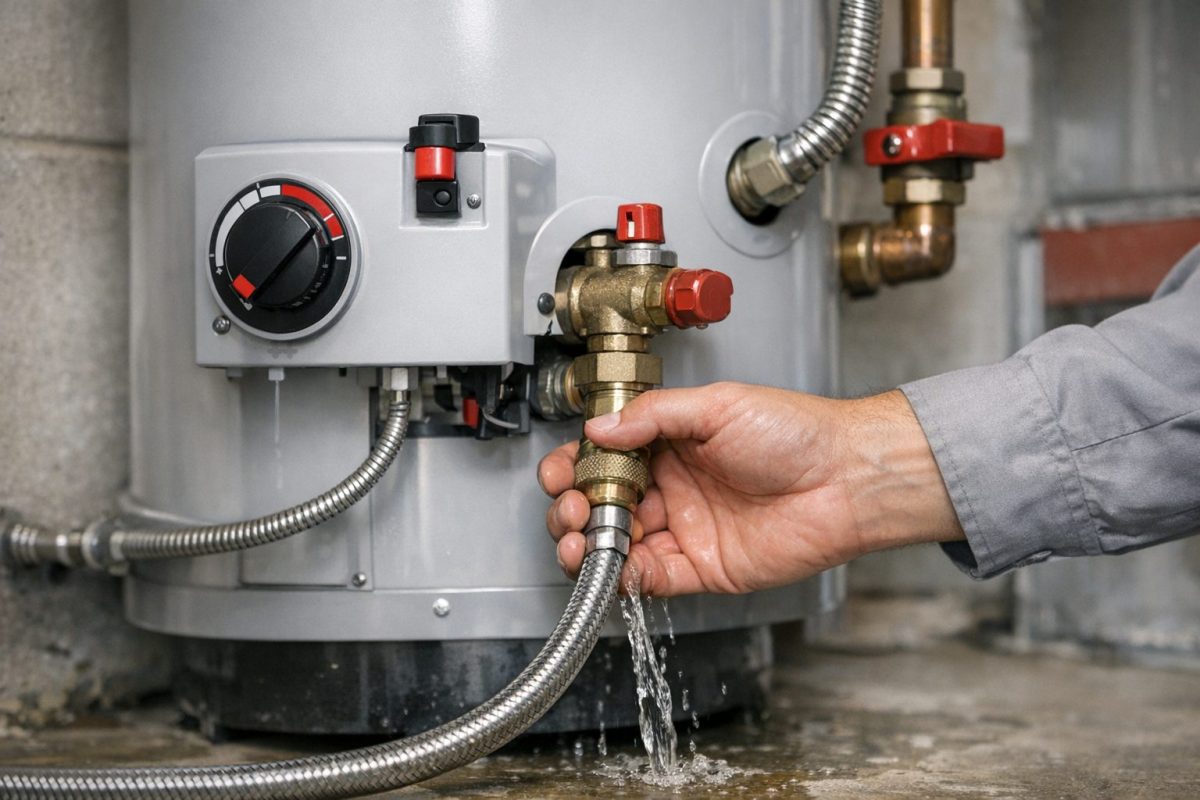
You can perform a basic flush yourself by connecting a garden hose to the drain valve at the base of the tank, turning off the cold-water inlet, and running water out until the flow runs clear rather than cloudy. However, if the sediment buildup is extensive or the drain valve is corroded, a professional technician can flush the tank more thoroughly and check for secondary damage like a weakened drain valve that may fail if you apply force.
Note: Flushing addresses sediment, but it won’t restore a unit that’s already lost 30% or more of its heating capacity due to tank corrosion or severe mineral encrustation. In those cases, efficiency recovery is temporary, and replacement becomes the more cost-effective long-term solution.
Other Mechanical Causes That Reduce Hot Water Output
Beyond thermostat settings and sediment, a few other mechanical issues can hamper summer performance:
- Dip tube failure: The dip tube inside the tank routes incoming cold water to the bottom of the tank so it can be heated. If this tube cracks or disintegrates, cold water mixes directly with hot water in the upper portion of the tank, reducing the usable hot water volume. You’ll notice the problem immediately: water temperature drops after just a few minutes of use, even if the heater is new or recently serviced.
- Heating element degradation (electric units): Over years of cycling, the electric heating element loses efficiency or fails entirely. A failing element heats more slowly, meaning recovery time stretches and summer demand quickly exhausts the tank’s capacity.
- Gas burner issues: On gas units, a corroded or partially blocked burner delivers less heat to the water. Signs include the pilot light staying on but the main burner not igniting reliably, or the unit cycling on and off without maintaining stable temperature.
- Undersized unit for household demand: If your home’s hot water demand has increased since the original installation, new family member, additional bathroom, or a shift in usage patterns, the unit may simply be too small for peak summer loads. A 40-gallon tank that served a two-person household adequately may fall short when a multi-generational family moves in.
These issues require a trained technician to diagnose and repair. Attempting to replace a heating element or dip tube without proper training risks electrocution (electric units) or gas exposure (gas units).
When to Stop Troubleshooting and Call for Professional Service
If you’ve adjusted the thermostat, waited for the system to stabilize, and tested the temperature with a thermometer, and hot water is still not reaching the desired temperature or volume, professional evaluation is the next step. Similarly, if you notice any of these signs, don’t delay:
- Rust-colored or cloudy water coming from the hot water tap (sign of internal tank corrosion)
- Persistent popping or rumbling sounds even after flushing the tank
- Visible moisture or pooling water around the base of the unit
- Hot water disappears almost immediately after starting a shower (dip tube or severe sediment issue)
- The unit is more than 10-12 years old and has never been serviced professionally
A licensed water heater technician can run diagnostic tests, checking actual water temperature under load, inspecting the heating element or burner, and reviewing the tank interior for corrosion, that pinpoint whether the problem is fixable or whether replacement makes more financial sense. In summer, when you’re without adequate hot water, waiting days for an appointment is painful. Discount Water Heaters offers same-day and next-day service appointments across the Treasure Coast, meaning you can schedule a professional diagnosis and repair or replacement on your timeline, not a three-day service queue.
Plan Your Next Step
Summer hot water shortages are annoying, but most are solvable without emergency replacement. Start by adjusting your thermostat to 130–135°F, wait an hour, and test the actual temperature with a thermometer. If that doesn’t restore adequate hot water, a professional inspection will identify whether sediment flushing, component repair, or replacement is the right path forward.
Florida summers are tough on the whole home comfort system. While you troubleshoot your water heater, consider scheduling an AC check with One Hour Heating & Air Conditioning® of Treasure Coast — available 24/7 for emergencies throughout Fort Pierce and the Treasure Coast.
If you also need air conditioning or heating service on the Treasure Coast, One Hour Heating & Air Conditioning of Treasure Coast offers 24/7 HVAC repair, maintenance, and installation across Fort Pierce, Port St. Lucie, Stuart, and surrounding areas.