
How to Check Your Water Heater Age: A Homeowner’s Guide to Reading the Label
As a homeowner, especially if you’re in Florida or another region with hard water and humid heat, weighing repair versus replacement options, your water heater’s age determines almost everything about its near future: whether a repair makes financial sense, how much longer you can safely rely on the unit, and when you should start budgeting for replacement. Yet most homeowners have no idea how old their water heater actually is. The serial number holds that answer, but the format is deliberately inconsistent across manufacturers, which means you need to know where to look and how to decode what you’re seeing. This guide walks you through finding that label, interpreting your water heater’s age and serial number, and understanding what that information means for your home and your wallet.
In our experience helping homeowners make water heater decisions, knowing your unit’s age is the single most impactful piece of information you can gather before choosing repair or replacement. Homeowners who take 15 minutes to decode their serial number typically save thousands by planning strategically, while those operating without this data often face emergency calls and inflated service costs.
Why Knowing Your Water Heater’s Age Actually Matters
Consider a homeowner we’ll call David. When his plumber recommended a water heater replacement, David hesitated, he didn’t know the unit’s age and assumed it had years left in it. Without that manufacture date, the conversation stalled. In reality, his unit was already 11 years old and past its expected lifespan, failure imminent. Two weeks later, the tank leaked, forcing an emergency service call at premium pricing instead of a planned replacement on his timeline.
Plumbing professionals consistently report the same pattern: homeowners who know their water heater’s age plan strategically and save thousands in unexpected repair costs, while those operating blind face emergency calls and inflated service fees. A water heater without a known manufacture date is like owning a car without checking the odometer. You can drive it, but you’re making decisions blind. Age directly affects three critical factors: warranty coverage, repair economics, and remaining lifespan.
Most manufacturer warranties on water heaters cover parts for 6 to 10 years from the manufacture date, not the date you bought it. If your unit is 8 years old and develops a failing heating element, the repair cost becomes your calculation, not the manufacturer’s. More importantly, an aging unit that fails catastrophically can leave you without hot water at the worst possible time, a cold shower at 6 AM before work, or worse, discovering a leak pooling under your utility room floor on a Sunday night when repair options are limited to emergency premium pricing.
Knowing your water heater’s age also lets you plan proactively rather than react in crisis mode. A unit that’s 7 or 8 years old in the Florida heat isn’t an immediate emergency, but it’s a conversation-starter for budgeting purposes. A unit that’s 12 years old is running on borrowed time, especially in Florida’s harsh environment where hard water and humidity accelerate corrosion and sediment buildup faster than national averages account for. That advance knowledge, obtained from reading your water heater’s age and serial number, is the difference between a planned replacement on your timeline and an urgent one that forces expensive next-day service or inflated emergency pricing.
Where to Find the Manufacturer Label and Serial Number
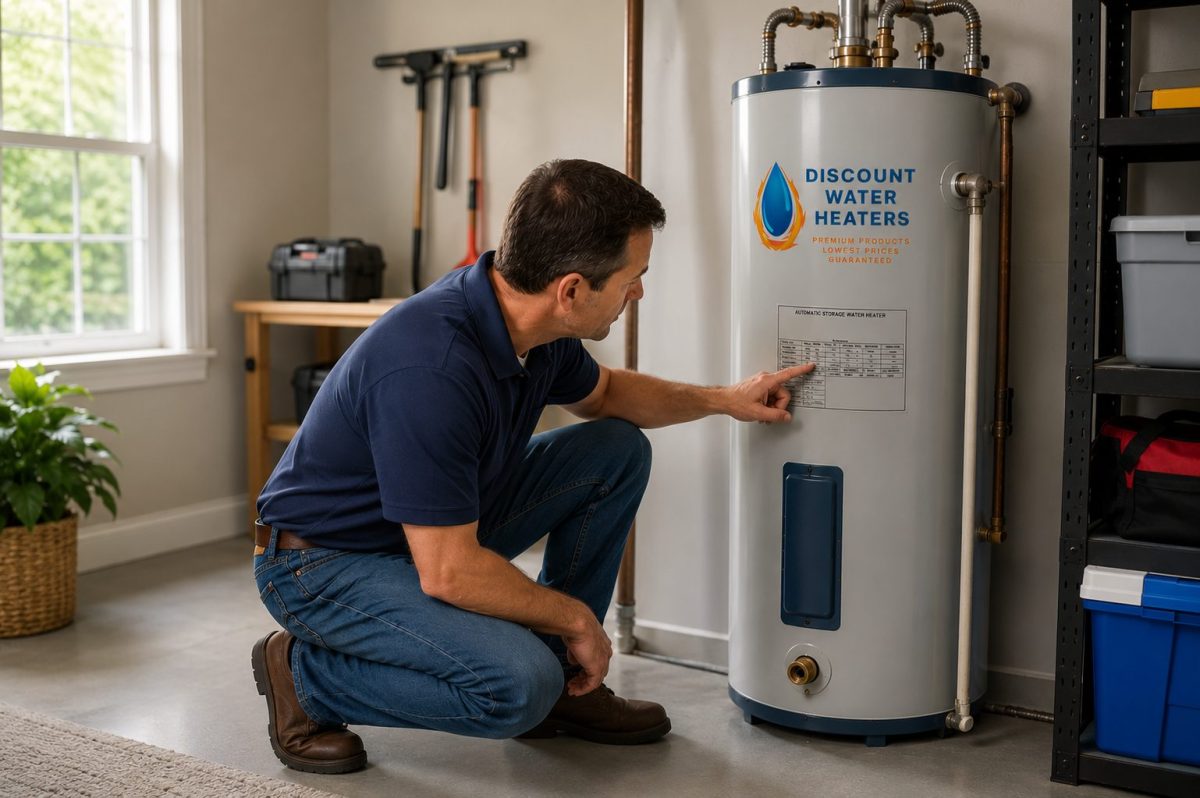
The label you’re looking for is a metal or plastic plate typically affixed to the upper third of a traditional tank-style water heater. On most units, it’s located on the side or front of the tank, roughly where the cold water inlet enters the unit. Run your hand along the upper portion of the tank; the label will feel like a small plaque or decal and usually displays the manufacturer’s logo, model number, and serial number printed or embossed on it.
If you have a tankless or heat pump water heater, the label is often mounted on the front control panel or inside an access cover, not on the tank itself. Check the front face first, and if it’s not immediately visible, look for a removable panel or door that might conceal it.
The label itself contains far more than just the age. You’ll typically see:
-
Model number (what you’ll need when sourcing parts or getting a replacement quote)
-
Serial number (the key to finding the manufacture date)
-
Capacity in gallons
-
Energy factor or uniform energy factor (UEF) rating, showing efficiency
-
BTU or wattage rating, indicating the unit’s heating power
-
First-hour rating, showing how much hot water the unit can deliver in an hour
If the label has faded beyond readability, common after 8 to 10 years in Florida’s intense sun and humid climate, check your original installation paperwork or the original purchase documentation. Some installers record the serial number on the work order or receipt. You might also find the serial number stamped directly onto the tank itself, usually near the top of the unit. Photograph whatever label remains legible and store it digitally; you’ll need the model and serial number if you ever request a service call or quote for replacement.
How to Decode the Serial Number and Find Your Water Heater’s Manufacture Date
Here’s where precision matters: there is no universal serial number standard across manufacturers. Each brand encodes the manufacture date differently, which is why many homeowners give up and assume their unit’s age is unknowable. It isn’t; you just need to match your brand to the correct decoding method.
Rheem, one of the largest water heater manufacturers, typically encodes the year and month in the first four characters of the serial number. The first character is usually a letter representing the month (A = January, B = February, and so on). The next two characters are the year in two-digit format (so 22 = 2022, 23 = 2023). The remaining digits represent the manufacturing plant and sequence. So a Rheem serial number starting with “F23” would indicate manufacture in June (F) of 2023.
Bradford White uses a similar but distinct approach. Their serial numbers typically begin with a letter indicating the month, but the year is represented in the second and third positions as a two-digit code. Checking the manufacturer’s website or a serial decoder tool specific to Bradford White will confirm the exact year your unit was made.
A.O. Smith embeds the manufacturing date differently again. Their serial numbers often include a code where the first digit represents the year of manufacture, and the second and third characters indicate the week of that year. You’ll need A.O. Smith’s decoder guide (available on their website) to translate that format into a calendar date.
State and American units have their own formats, equally logical but equally brand-specific. Rather than try to memorize six different systems, use the manufacturer’s official website, nearly all major brands publish a serial number decoder tool or reference chart. Enter your brand name and serial number, and the tool will return the exact manufacture month and year. As a backup, third-party serial decoder websites exist specifically for this purpose and can cross-check your result if the manufacturer’s tool is unclear.
Consider a scenario where you find a serial number on an older Rheem unit that reads “M19A6789.” The M indicates manufacture in December (month 13 or later cycles back; A=1, B=2…M=13). The 19 is the year, 2019. Without knowing that decoding system, you might think the unit is from 2009, not 2019, which dramatically changes your replacement timeline. Knowing the correct manufacture date prevents that kind of costly planning error.
Understanding the Other Specifications on the Label
The serial number tells you the age, but the rest of the label tells you whether that age matters and what to expect from the unit going forward.
The energy factor or UEF rating, printed on modern units as a decimal between 0.5 and 0.98, indicates how efficiently the unit converts fuel (gas, electric, or other source) into usable hot water. An older water heater from 2013 might carry a UEF of 0.62. A current unit manufactured in 2026 might carry a UEF of 0.82 or higher. That difference doesn’t sound dramatic until you run the numbers on annual energy costs, but across 10 years, replacing a low-efficiency older unit with a modern high-efficiency model can save hundreds of dollars annually depending on your local utility rates and hot water usage patterns.
The capacity in gallons tells you the tank’s size, typically 30, 40, 50, or 75 gallons for residential homes. If your household has grown since the unit was installed, or if you’ve added bathrooms and now experience cold showers mid-shower, the original capacity may no longer match your actual demand. The first-hour rating on the label helps clarify this: if your unit’s first-hour rating is 45 gallons but your household’s typical morning draw (all showers, dishwasher, laundry running simultaneously) approaches 60 gallons, you now have concrete evidence that an upgrade to a larger tank, or a switch to a tankless or heat pump water heater, would solve a real problem.
The model number is practical information. When you’re ready to explore repair or replacement options, the model number is what service technicians need to identify parts availability, price the replacement unit, and match the specifications of any potential upgrade. Photograph it and save it alongside the serial number and age you’ve just decoded.
What Your Water Heater’s Age Tells You About Remaining Lifespan
The typical lifespan of a tank-style water heater ranges from 8 to 12 years under normal conditions. In Florida, that timeline compresses. Hard water mineral deposits accumulate faster in the state’s mineral-heavy supply, and high humidity accelerates corrosion of the tank’s interior. A water heater in Tampa, Miami, or Fort Pierce often shows signs of decline, reduced efficiency, longer heating times, rust-colored water, by year 8 or 9, whereas the same brand and model in a northern state might remain reliable into year 11 or 12.
Think of your unit’s remaining lifespan in tiers:
-
Years 1, 6: Unit should operate reliably with routine maintenance (annual flushing, temperature checks). Repairs, when needed, typically make financial sense.
-
Years 7, 9: Unit is aging. Minor repairs still make sense, but major issues (a leaking tank, failed heating element) should prompt a replacement conversation. Budget planning should begin.
-
Years 10+: Unit is operating on borrowed time. Any significant repair should be evaluated against the cost of replacement, and you should schedule a replacement before a catastrophic failure forces an emergency service call.
Florida units in the 8 to 10-year range deserve special attention. A water heater that’s 8 years old and showing minor symptoms, slightly longer heating times, occasional rumbling during the heating cycle, may have 2 to 3 years left, or it may be weeks away from failure.
Your Next Steps: What to Do With This Information
Now that you know how to find and decode your water heater’s age, here’s exactly what to do:
-
Locate the label on your unit right now. Take a clear photograph of the serial number, model number, and any other visible information. Store the photo in your phone’s cloud backup or a home maintenance folder so you have it when you need it.
-
Decode the serial number using your manufacturer’s decoder tool. Visit the manufacturer’s website (Rheem, Bradford White, A.O. Smith, State, American, or whichever brand you own) and enter your serial number to confirm the exact manufacture date. Write down the month and year in an easy-to-find place, such as a home maintenance spreadsheet or your homeowner’s binder.
-
Match your unit’s age to the lifespan tier above. If your water heater is 7 years old or older, begin budgeting for replacement within the next 1 to 3 years. If it’s 10 years old or older, schedule a consultation with a licensed plumber to assess its condition and discuss replacement options before failure occurs.
-
If you experience any of these warning signs, rust-colored water, longer heating times, rumbling noises, visible corrosion, or active leaks, call a plumber immediately for a professional assessment. The cost of a service call is far less than the cost of water damage from a tank rupture or an emergency replacement.
Take Control of Your Water Heater Before It Takes Control of You
Your water heater’s age is now in your hands. Armed with the manufacture date, capacity, efficiency rating, and remaining lifespan estimate, you’re no longer making blind decisions. You can plan replacement on your schedule, budget accordingly, and avoid the stress and cost of emergency failures. The 15 minutes you spend finding and photographing that label today could save you thousands of dollars and countless hours of inconvenience down the road. Start now, decode your serial number, and put yourself in the driver’s seat.
Contact us today for a professional water heater assessment or to discuss replacement options tailored to your home and budget.
Serial-number dating works the same way on furnaces and air handlers. If you are checking the age of your HVAC system too, One Hour Heating & Air Conditioning can date and inspect it.
Related Resources for Florida Homeowners
Once you know your water heater’s age, take action. Review 7 signs your Treasure Coast water heater is about to fail to identify early warning signs. Compare your options with our guide on how much a water heater costs in 2026. And before you buy, learn how long water heaters last in Florida’s climate to choose the right unit lifespan for your needs.
Related resources: Learn more about hard water effects on water heaters, water heater repair, water heater maintenance.
If you’re handy enough to check your own water heater label but are considering a career change into the skilled trades, The Blue Collar Recruiter connects candidates with hands-on careers in plumbing, HVAC, and electrical work.