
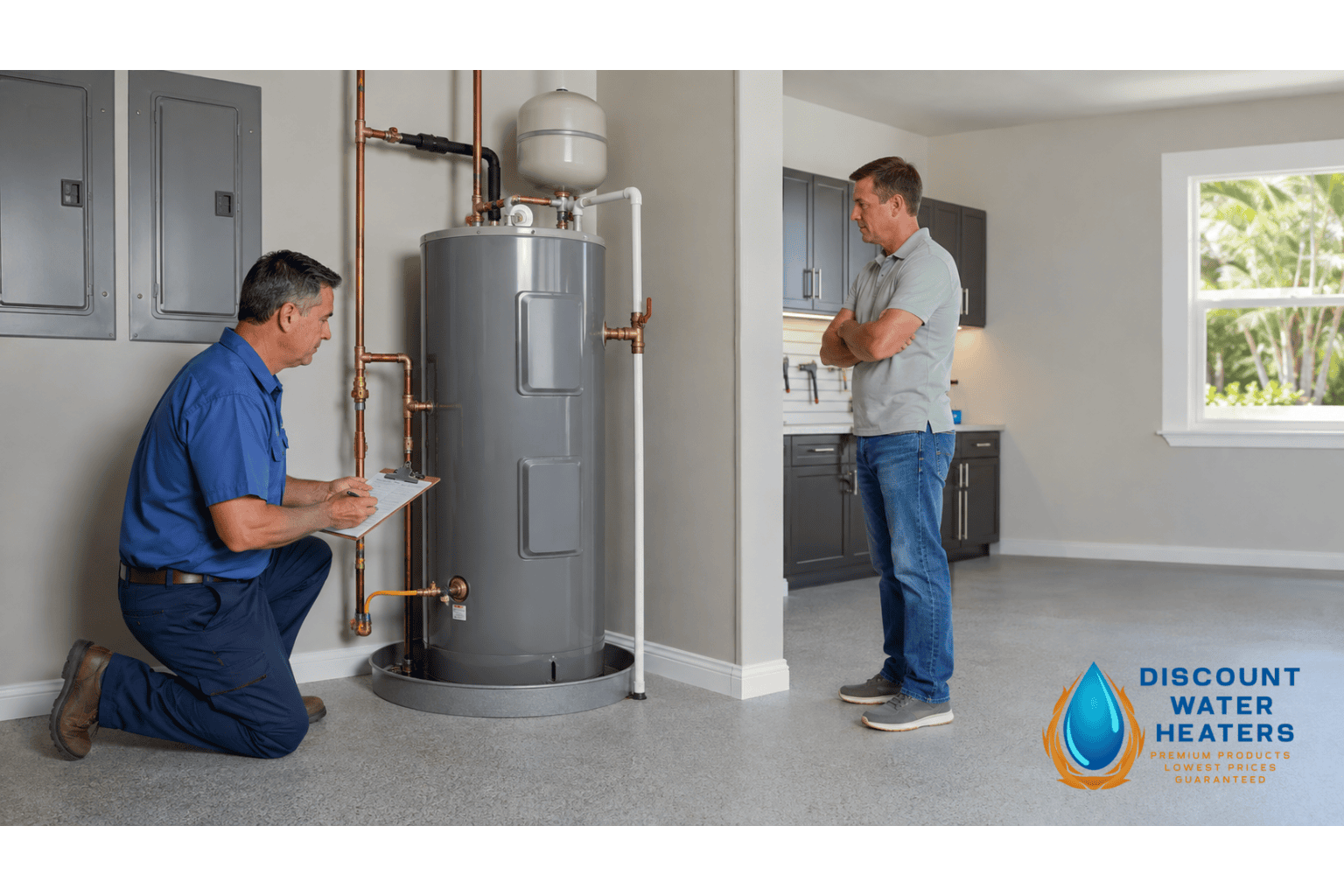
A water heater is a system, not just a tank
A replacement can look simple because the new appliance resembles the old one. In reality, the installation must coordinate water, pressure, temperature, fuel or electricity, combustion, venting, drainage, structural support, clearances, permits, and manufacturer requirements. Small shortcuts can create leaks, poor performance, code problems, fire, carbon-monoxide exposure, shock, or scalding.
Requirements vary by equipment, building, manufacturer, and local code. Homeowners should use a qualified contractor and treat this guide as a checklist for asking informed questions, not as instructions for unlicensed work.
Mistake 1: Replacing by tank size alone
Two units with the same gallon capacity can provide different first-hour performance. Correct sizing considers household occupancy, simultaneous fixtures, large tubs, inlet-water temperature, recovery, setpoint, fuel input, and usage pattern. Tankless equipment also requires flow and temperature-rise calculations.
Oversizing can increase cost and standby loss, while undersizing causes repeated shortages. Compare rated performance and the complete household demand rather than assuming the old size was correct.
Mistake 2: Skipping permits or inspection
Permits and inspection help verify that the work meets applicable safety and building requirements. A contractor should identify required approvals before installation and include them in the proposal. Requirements can differ by jurisdiction and project scope.
A low bid that excludes permits, code corrections, disposal, venting, electrical work, or drainage may not be comparable to a complete installed price. Ask exactly what is included and who is responsible for each step.
Mistake 3: Incorrect temperature-and-pressure relief piping
The temperature-and-pressure relief valve is a critical safety device. Its discharge line must use approved material, follow the required route and termination, remain unobstructed, and avoid valves or restrictions. Never cap or plug the discharge because it drips.
The U.S. Department of Energy’s heat-pump water-heater installation job aid calls for a T&P valve installed according to code and manufacturer specifications, with the discharge routed to an observable location as required.
Mistake 4: Missing or poorly drained pan
Where leakage could damage the building, a properly sized drain pan and suitable drain route may be required. A pan that has no drain, slopes incorrectly, terminates where water cannot be seen, or is too small provides little protection.
A pan does not replace leak repair. It is a secondary safeguard. Ask where the drain terminates and whether the route can flow by gravity without creating damage or a hidden blockage.
Mistake 5: Ignoring thermal expansion
Heating water increases its volume. In a closed plumbing system created by a check valve, backflow device, or pressure-reducing valve, expansion may raise pressure unless it is controlled correctly. An expansion tank must be properly located, sized, charged, and supported when required.
Installing a tank without checking incoming pressure and system configuration can lead to nuisance relief-valve discharge, shortened component life, or leaks. The contractor should diagnose the cause rather than simply replacing the relief valve.
Mistake 6: Reusing an incompatible vent
Gas water heaters need appropriate combustion air and venting. The vent material, diameter, rise, length, termination, draft, clearances, chimney condition, and interaction with exhaust equipment must fit the selected unit and installation.
A vent is not acceptable merely because it connects. Atmospheric, power-vented, direct-vent, and condensing equipment have different requirements. Improper venting can allow combustion products to enter the building.
Mistake 7: Treating gas connections casually
Gas type, supply pressure, pipe sizing, shutoff location, sediment control where applicable, approved connectors, leak testing, and appliance setup all matter. Converting between natural gas and propane requires equipment and procedures specifically approved for the model.
Never test for gas leaks with an open flame. If gas odor is present, leave the area and follow the utility or emergency authority’s instructions.
Mistake 8: Using an inadequate electrical circuit
Electric resistance, heat-pump, power-vented, and electronic gas units can have different voltage, amperage, breaker, conductor, disconnect, grounding, and working-clearance requirements. The old circuit may not suit the new equipment.
Hardwired connections and circuit changes should be completed by qualified professionals as required. Covers must be closed, strain relief and grounding should be correct, and the circuit should be labeled.
Mistake 9: Ignoring space, airflow, and service clearance
Equipment needs room for inspection, maintenance, repair, and eventual replacement. Heat-pump models also need suitable air volume, airflow, condensate drainage, filter access, and a plan for sound and cool exhaust air.
Gas equipment may have combustion-air and enclosure requirements. Do not crowd the unit with storage or block controls, drains, valves, filters, vents, or access panels.
Mistake 10: Failing to manage condensate
Condensing gas and heat-pump equipment can produce water that must be routed to an approved location. The installation may require proper slope, trapped or neutralized condensate where applicable, overflow protection, and freeze or clog considerations.
A hose placed loosely on the floor is not a durable drainage plan. Ask how the condensate route will be inspected and maintained.
Mistake 11: Starting the heater before it is full
An electric tank can damage its heating elements if energized before the tank is completely filled and air is purged. Every system should be filled, checked for leaks, started in the correct sequence, and tested through a complete operating cycle.
Startup should verify temperature, controls, venting or combustion as applicable, drainage, pressure behavior, and hot-water delivery. Do not assume silence means correct operation.
Mistake 12: Setting temperature without verification
A thermostat setting is not always the same as the temperature at a fixture. The U.S. Consumer Product Safety Commission’s scald-prevention guidance discusses the serious risk of hot-water burns and recommends considering a residential setting around 120°F, while household health needs and appliance requirements may require professional guidance.
Test delivered temperature after the system stabilizes and consider mixing protection where appropriate. Children, older adults, and people with reduced sensation can be especially vulnerable to scald injury.
Mistake 13: Leaving no documentation
Homeowners should receive the model and serial information, manual, warranty, permit or inspection records, installed components, temperature setting, maintenance needs, and contractor contact information. Photograph concealed or difficult-to-see work before access is closed.
Discount Water Heaters’ replacement service can evaluate the existing system and provide a site-specific scope. Homeowners coordinating water heating with comfort equipment can also consult One Hour Air Conditioning & Heating of the Treasure Coast.
Use qualified people and a complete scope
A quality installation depends on diagnosis, equipment selection, code knowledge, workmanship, startup, and documentation. Service companies building qualified field teams can use The Blue Collar Recruiter as part of a broader workforce strategy.
Before approving work, compare complete proposals and ask about permits, sizing, venting, electrical or gas changes, relief piping, drainage, expansion control, disposal, warranty, and final testing. The lowest appliance price is not necessarily the lowest installed risk.
Frequently asked questions
Can a homeowner install a water heater?
Rules vary, but the work involves high-consequence plumbing, electrical, gas, combustion, pressure, and code issues. A qualified, properly authorized contractor is the safer choice.
Why is my new relief valve dripping?
Possible causes include thermal expansion, excessive supply pressure, high temperature, debris, a defective component, or an installation problem. Do not cap it; have the system evaluated.
What should be tested after installation?
Verify leaks, temperature, pressure behavior, controls, relief piping, drains, hot-water delivery, and, where applicable, combustion, draft, venting, condensate, electrical protection, and heat-pump airflow.