
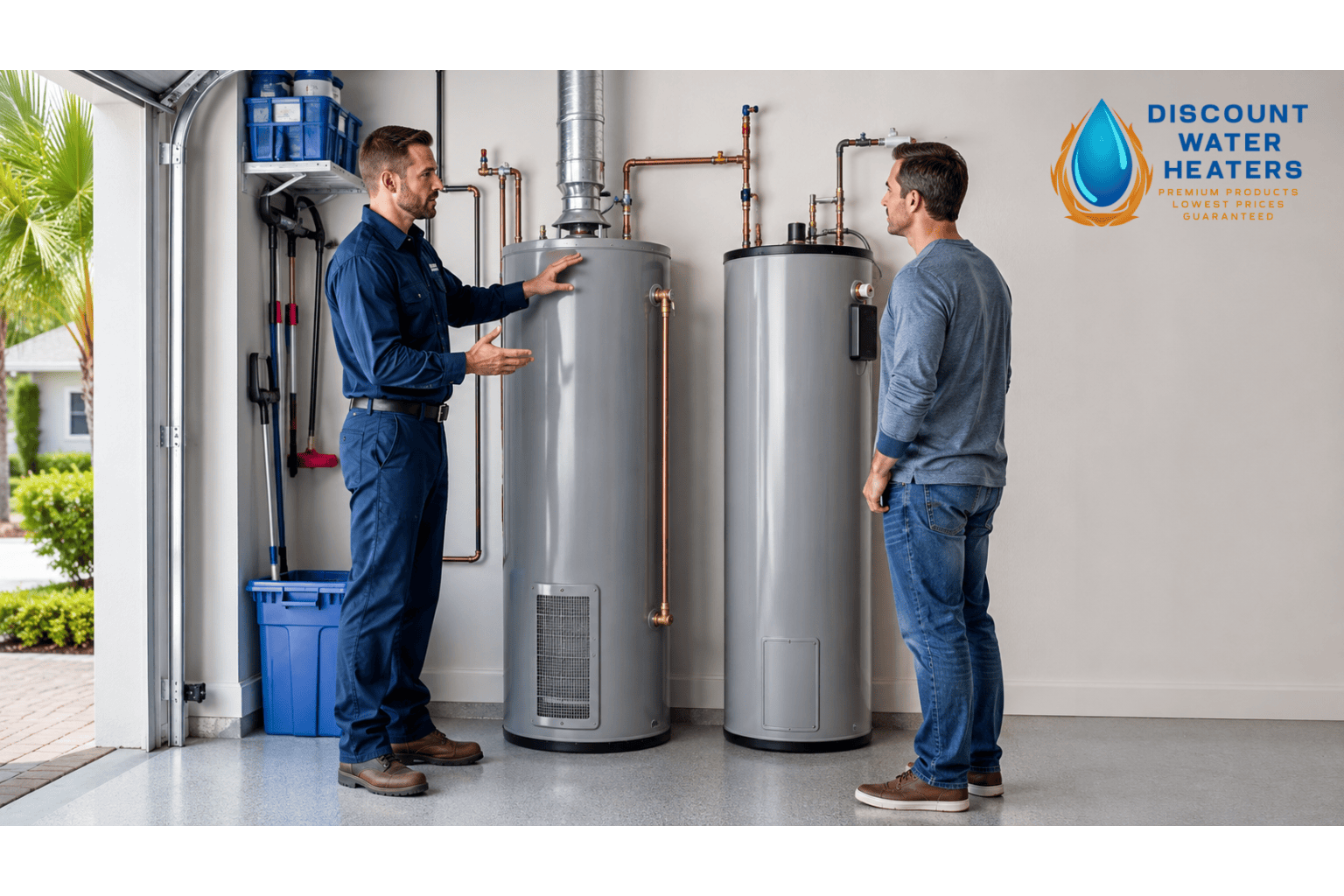
The best fuel is the one that fits the home and the complete cost
Gas vs. electric water heaters cannot be compared by appliance price alone. The right choice depends on available utilities, household demand, energy rates, installation conditions, ventilation, electrical capacity, space, efficiency, maintenance, resilience priorities, and the owner’s expected time in the home.
A like-for-like replacement is often the simplest option, but replacement time can be an opportunity to compare conventional gas storage, standard electric resistance, high-efficiency gas, tankless, and electric heat-pump water heaters. Each technology solves a different combination of needs.
How gas storage water heaters work
A conventional gas unit burns natural gas or propane to heat water in a storage tank. Combustion products must be vented safely, and the installation must provide appropriate gas supply, combustion air, clearances, shutoffs, and drainage.
Gas storage often provides strong recovery, which can help households with concentrated demand. Efficiency, standby loss, vent type, burner design, tank size, and first-hour rating vary by model.
How electric resistance water heaters work
A standard electric tank uses heating elements controlled by thermostats. It needs a correctly sized dedicated circuit, disconnect or breaker arrangement as applicable, grounding, wiring, and safe access. It does not require combustion venting.
Electric resistance tanks are widely serviceable and can simplify installations where gas is unavailable. Recovery may be slower than some gas models, so capacity and first-hour performance must match the household.
Heat-pump water heaters change the electric comparison
A heat-pump water heater moves heat from surrounding air into the tank rather than relying only on resistance elements. It can use substantially less electricity, but requires adequate space, suitable temperatures, condensate drainage, air movement, and planning for sound and cooling effects.
ENERGY STAR publishes current benefit and savings guidance for certified heat-pump models. Actual savings depend on household size, electricity rates, operating mode, location, hot-water use, and installation.
Fuel availability can decide the question
If the home has no gas service or propane system, adding fuel may require utility coordination, trenching, a tank, regulators, gas piping, venting, permits, and other work. If electrical capacity is limited, converting to electric may require a panel, circuit, wiring, or service upgrade.
Ask for a site-specific scope. The cost of bringing the energy source to the heater may exceed the difference between appliances. Do not assume an existing connection is properly sized for a higher-input replacement.
Compare operating cost with local rates
Gas and electricity prices vary by provider, rate plan, fuel type, season, and location. Compare estimated annual energy use for suitable models using current utility rates. Include fixed service charges when adding a fuel solely for water heating.
Efficiency ratings should be compared within the appropriate product category and draw pattern. The U.S. Department of Energy’s consumer water-heater resources describe regulated product types using gas and electricity, including storage, instantaneous, and heat-pump units.
Recovery and household demand matter
A household with back-to-back showers, a large tub, multiple bathrooms, or simultaneous appliance use may need stronger recovery or more storage. Compare first-hour rating for tanks and flow at the required temperature rise for tankless units.
Do not oversize automatically. Larger tanks can increase standby loss, cost, and space. A professional should estimate peak demand and account for inlet-water temperature, setpoint, mixing valves, and household changes.
Gas requires combustion safety and venting
Gas equipment must vent correctly and receive adequate combustion air. Chimney condition, vent material, draft, clearances, room volume, exhaust fans, and other appliances can affect the installation. Condensing models also require condensate management.
Never reuse a vent merely because it connects physically. The proposed model, manufacturer instructions, fuel code, building conditions, and local requirements determine the venting system.
Electric equipment requires adequate wiring
Electric tanks and heat-pump units need the proper voltage, amperage, breaker, conductors, grounding, and clear working space. An old circuit may not be suitable for a different model. Electrical work should be included in the permit and installation scope when required.
A heat-pump unit may have different circuit and space needs from a standard electric tank. Some models offer multiple configurations, but exact requirements must come from the selected equipment.
Installation cost can outweigh appliance price
A replacement estimate may include removal, permits, drain pan, expansion control, valves, piping, venting, gas or electrical changes, condensate, structural or access work, code corrections, and startup testing. Compare complete installed proposals rather than online appliance prices.
A fuel conversion should have a clear reason: lower long-term cost, better recovery, space, efficiency, resilience, or another measurable benefit. Discount Water Heaters’ replacement service can evaluate the actual home before recommending a conversion.
Maintenance differs by technology
All storage tanks may need inspection for leaks, corrosion, sediment, valves, and anode condition as applicable. Gas units add burner, combustion, and vent checks. Electric units add element, thermostat, wiring, and connection checks. Heat-pump units may also have filters, condensate, fans, and refrigeration components.
Water quality affects every type. Hard-water scale can reduce heat transfer and clog tankless passages. Follow the manufacturer’s schedule and adjust maintenance based on measured conditions.
Outages and resilience require realistic expectations
Standard electric units cannot heat during a power outage. Many modern gas units also need electricity for ignition, fans, controls, or pumps. A standing-pilot gas tank may operate differently, but owners should verify the exact model rather than assume gas guarantees hot water.
Generators, transfer equipment, gas supply during emergencies, and flood exposure introduce separate safety issues. Never energize or relight damaged equipment before professional evaluation.
Florida conditions can favor different options
Warm garage temperatures can support heat-pump performance in some Florida homes, although condensate, air volume, sound, and garage use still matter. Homes with natural gas may value recovery or tankless options. Coastal corrosion, storm exposure, utility availability, and local rates vary across the state.
Homeowners coordinating HVAC and water-heating decisions can consult One Hour Air Conditioning & Heating of the Treasure Coast while keeping each system’s load, installation, and budget separate.
Which one should you choose?
Choose gas when fuel is safely available, the installation and venting are appropriate, recovery fits demand, and total ownership cost is competitive. Choose standard electric when simplicity, availability, and installation fit the home. Consider heat pump when space and conditions support it and long-term electricity savings justify the higher initial cost.
If the existing unit is failing, Discount Water Heaters’ repair team can determine whether repair remains sensible. When replacement is necessary, compare at least two properly sized options using complete installed cost and realistic operating assumptions.
Frequently asked questions
Is gas always cheaper to operate than electric?
No. Rates, efficiency, fuel type, fixed charges, household use, and technology matter. Heat-pump electric models can change the comparison substantially.
Can I replace gas with electric?
Often, but the home may need adequate electrical capacity, a dedicated circuit, wiring, permits, gas-line closure, and vent changes. Get a complete site-specific scope.
Which type recovers hot water faster?
Many gas storage units recover faster than standard electric resistance tanks, but model input, tank size, efficiency, and first-hour rating determine actual performance. Heat-pump modes also vary.