
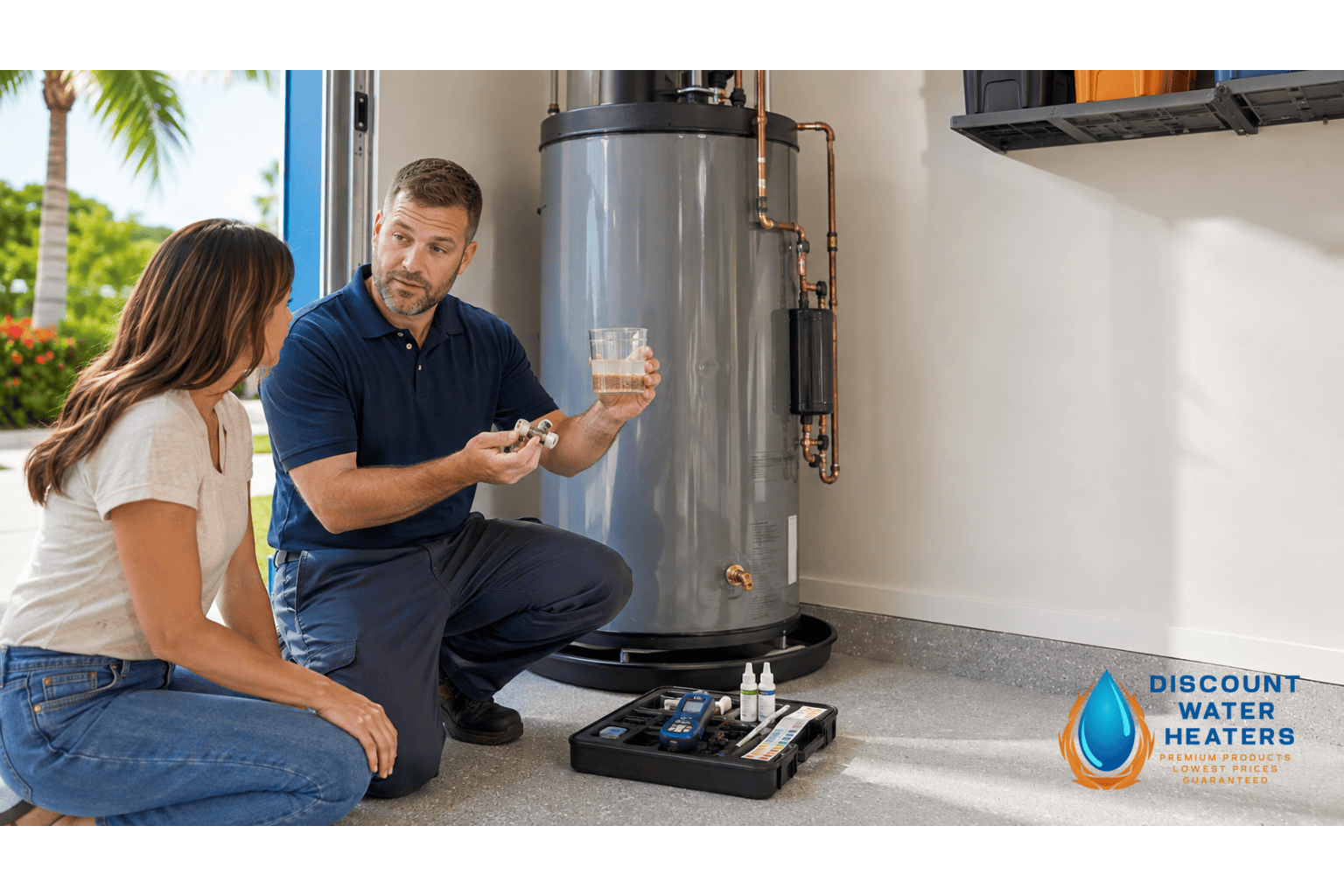
Your water heater interacts with every gallon that enters the home
Florida water quality and water heaters are closely connected. Minerals can form scale, sediment can collect in tanks and screens, disinfectants and chlorides can influence materials, and private-well conditions may change over time. These factors affect efficiency, noise, flow, maintenance, components, and sometimes service life.
There is no single ‘Florida water.’ Conditions vary by utility, aquifer, well depth, treatment process, neighborhood plumbing, and season. Start with the home’s actual water rather than a statewide assumption. A water-quality report or professional test can help distinguish hardness from iron, sulfur odor, sediment, corrosion, or another issue.
Hard water creates scale
Hardness mainly reflects dissolved calcium and magnesium. When water is heated, minerals can form scale on tank surfaces, heating elements, heat exchangers, valves, and fixtures. Scale can reduce heat transfer, restrict small passages, increase noise, and make equipment work harder.
The U.S. Environmental Protection Agency’s 2026 WaterSense guide explains that hard-water scale can decrease water-heater efficiency and shorten the life of plumbing products and appliances. The impact depends on hardness level, temperature, use, equipment design, and maintenance.
Storage tanks collect sediment
Minerals, sand, corrosion products, and other particles can settle at the bottom of a tank. Accumulation may reduce usable capacity, contribute to rumbling or popping, cover lower heating elements, and make draining more difficult. Sediment does not always mean the tank has failed, but it changes maintenance needs.
Flushing recommendations vary by manufacturer and water conditions. A. O. Smith’s maintenance guidance describes routine inspection and flushing as part of water-heater care. Follow the exact owner’s manual, and ask a professional before disturbing an older, neglected, leaking, or heavily scaled unit.
Tankless heat exchangers have narrow water paths
Tankless units do not store a full tank of sediment, but mineral scale can form inside the heat exchanger and reduce performance or trigger errors. Harder water and heavier use may require more frequent descaling than a generic annual schedule.
Maintenance should follow the manufacturer, model, water quality, and installation. A service technician may inspect inlet screens, flush with an approved solution, verify flow and temperature, check combustion or electrical operation, and confirm that isolation valves and drains were installed correctly.
Water temperature affects scaling and energy
Higher storage temperatures can increase energy use, scald risk, and mineral precipitation. Do not lower temperature below safe system guidance or change settings casually; household health, plumbing layout, code, and manufacturer instructions matter.
If hot water is running out, raising the thermostat may hide a capacity, element, burner, sediment, or demand problem. Have the cause diagnosed rather than using temperature as the only solution.
Corrosion is more complicated than hardness
Water chemistry, dissolved oxygen, chlorides, pH, conductivity, temperature, dissimilar metals, electrical grounding, installation, and protective components can influence corrosion. Hard water is not the same as corrosive water, and soft water is not automatically destructive when treatment is properly selected and maintained.
Storage tanks use anode protection and a glass lining, while heat exchangers and plumbing use different materials. Inspect sacrificial anodes according to manufacturer guidance. The right anode type and replacement interval depend on the heater and water, not a universal calendar.
Odor and discoloration need diagnosis
A rotten-egg odor, metallic taste, black particles, or rusty water can originate in the source water, water heater, anode interaction, bacteria, plumbing, treatment equipment, or nearby work. Compare hot and cold water at several fixtures and note whether the condition is constant or appeared suddenly.
Do not remove an anode permanently or add chemicals without understanding the tank warranty, materials, and health implications. A qualified water-treatment or plumbing professional may need to test the water and coordinate a targeted remedy.
Municipal water and private wells require different homework
Public utilities provide consumer confidence reports with regulated water-quality information. Those reports can show source, disinfectant, detected contaminants, and other measures, although hardness may require a separate utility lookup or test. Conditions inside the home can still differ because of service lines and plumbing.
Private-well owners are responsible for testing and treatment. Wells can have hardness, iron, manganese, sulfur odor, sediment, salinity, microbial concerns, or changing conditions. Water-heater maintenance does not make unsafe source water safe; use appropriate testing and local health guidance.
Should you install a water softener?
A properly sized ion-exchange softener can reduce calcium and magnesium and therefore reduce scale. It also uses salt and water during regeneration and requires maintenance. Some households may need filtration or another treatment instead of, or before, softening.
Test first. Size the system from actual hardness and household use, choose efficient demand-initiated regeneration, verify local restrictions and septic considerations, and install it in the correct sequence. The EPA notes that treatment should match the problem and that oversizing can waste water.
Treatment systems can affect the heater
Filters, softeners, reverse-osmosis equipment, chemical feed, and well systems need proper flow, pressure, bypasses, drainage, and maintenance. A clogged filter can reduce flow. An incorrectly programmed softener can waste water or fail to control hardness. Treatment changes may affect warranties or material compatibility.
Tell the water-heater installer what treatment equipment exists and provide available test results. If a system serves only selected fixtures, identify whether the water heater receives treated or untreated water.
Florida’s coastal and storm conditions add context
Coastal air can corrode exterior components and nearby metal even when the water inside is acceptable. Flooding or saltwater exposure can make electrical, gas, controls, insulation, and tanks unsafe. Equipment exposed to floodwater should not be restarted until evaluated under appropriate safety guidance.
Storm-related utility changes, well outages, pressure loss, or sediment disturbance can also affect water appearance and equipment. Follow utility or health advisories and do not assume the water heater removes contaminants.
Build maintenance around measured conditions
Locate the model and manual, learn the source-water hardness, inspect for leaks and corrosion, keep the area clear, test safety devices only as directed, service treatment equipment, and document maintenance. For tankless equipment, follow the required inspection and descaling procedure. For storage tanks, evaluate flushing and anode service based on condition.
If performance is declining, Discount Water Heaters’ repair service can diagnose whether water quality, a component, installation, or normal equipment aging is responsible. When replacement is necessary, Discount Water Heaters’ installation team can match the model and maintenance plan to the home.
When replacement may be the better answer
Maintenance cannot reverse a leaking tank, advanced corrosion, a damaged heat exchanger, or every effect of years of scale. Compare age, tank condition, repair history, parts, efficiency, capacity, warranty, and complete installed cost. Homeowners coordinating other comfort equipment can also consult One Hour Air Conditioning & Heating of the Treasure Coast.
Frequently asked questions
Does Florida have hard water?
Many Florida homes experience mineral hardness, especially where groundwater is used, but the level varies. Check the local utility, consumer confidence report, or a reliable test for the specific home.
How often should a Florida water heater be flushed?
Follow the manufacturer and adjust for water conditions, use, age, and service history. An older or neglected tank may need professional evaluation before flushing.
Will a water softener make my water heater last longer?
Reducing hardness can limit scale, but lifespan also depends on installation, corrosion, temperature, demand, maintenance, environment, and equipment quality. Select and maintain treatment based on testing.