
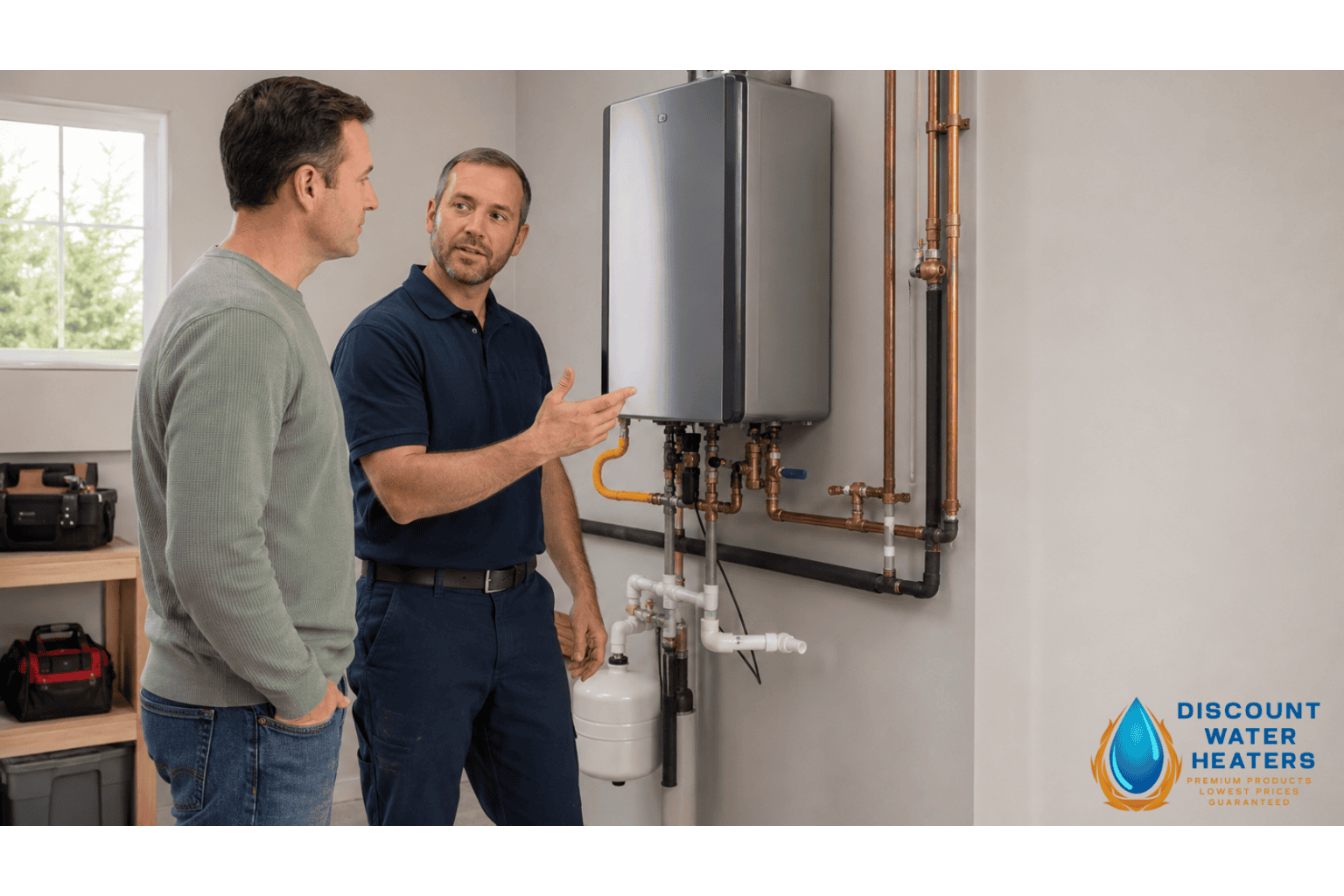
Tankless is valuable when the system fits the home
Is a tankless water heater worth it? For some households, the answer is yes: on-demand heating can reduce standby losses, free floor space, and provide long periods of hot water when the unit is sized correctly. For others, a well-selected storage water heater offers a lower upfront cost and simpler replacement. The right answer depends on fuel, simultaneous demand, installation conditions, water quality, maintenance, and how long you expect to stay in the home.
Do not compare only the price of the appliance. Compare the installed scope and the years of service you expect. A tankless conversion may require gas, venting, electrical, condensate, water-line, permit, and code work that a like-for-like tank replacement does not.
How a tankless water heater works
A tankless unit heats water as flow begins instead of storing a large volume at a set temperature around the clock. A sensor detects demand, the heat source activates, and the unit modulates to deliver hot water within its rated temperature rise and flow range. When the fixture closes, heating stops.
This reduces storage or standby losses, but it does not create unlimited capacity. The system can run for a long time, yet the number of fixtures it can serve simultaneously is limited by flow rate and the temperature increase required.
Benefit 1: lower standby energy losses
Because tankless equipment does not keep a full tank hot continuously, it can use less energy under suitable conditions. Savings vary with household volume, fuel prices, incoming water temperature, equipment efficiency, set point, installation, and maintenance. A marketing percentage is not a guarantee for a specific home.
Look at the unit’s efficiency rating, realistic annual operating estimate, local utility costs, and installed price. Then compare the likely difference over your expected ownership period. Energy savings alone may not repay a complex conversion quickly, but efficiency can be one of several benefits.
Benefit 2: long-duration hot water within the flow limit
A properly sized unit can continue heating as long as fuel, water, and rated capacity are available. That can help households that fill a large tub or take showers back-to-back. It does not mean every shower, sink, and appliance can run at once.
Sizing starts with simultaneous gallons per minute and required temperature rise, not just bedroom count. A contractor should ask how the household actually uses hot water, identify the highest likely combination of fixtures, and consider seasonal incoming-water temperature.
Benefit 3: compact size and flexible placement
Wall-mounted equipment can free space where a storage tank once stood. That can be valuable in a small utility room, garage, closet, or remodel. Placement still must satisfy service clearance, venting, combustion-air, drainage, freeze-protection, and code requirements.
Do not assume the old tank location is automatically ideal. The total pipe distance to frequently used fixtures affects wait time, and a new location may change gas, electrical, vent, and condensate costs.
The main tradeoff: higher installation cost
A direct tankless replacement can be straightforward when the home already has suitable infrastructure. A conversion from storage equipment may require a larger gas line or meter review, new venting, a dedicated electrical circuit, service upgrades for electric models, condensate disposal, water-line changes, permits, or wall work.
Request a written installed estimate that separates equipment, accessories, labor, permits, removal, venting, gas or electrical work, and warranty. Compare it with a properly sized storage option through Discount Water Heaters’ replacement service.
Flow rate can become the deciding factor
Every tankless unit has a capacity curve. As the required temperature rise increases, available flow may decrease. A unit that supports two fixtures under one condition may not support them under colder incoming-water conditions or a higher set point.
Low-flow fixtures can help, and some large homes use multiple units or a carefully designed recirculation system. Those choices add cost and complexity. A truthful proposal should identify the expected simultaneous-use limit so the household knows what the system will and will not do.
Maintenance is part of the investment
Mineral scale can reduce heat transfer and restrict passages, especially where water is hard. Tankless systems may need periodic inspection, flushing or descaling, filter cleaning, combustion checks, and condensate or vent inspection according to the manufacturer and site conditions. Frequency is not identical for every home.
Skipping maintenance can reduce performance and affect warranty coverage. Ask what annual service involves, what water treatment is recommended, and what access the installer will provide. Storage water heaters also need maintenance; tankless is not maintenance-free.
Wait time is mostly a pipe-distance issue
Tankless equipment heats on demand, but hot water still must travel from the heater to the fixture. A distant bathroom can experience a similar wait as it did with a tank. Some units and homes use recirculation, but it must be designed and controlled correctly or it can reduce expected energy savings.
If faster delivery is a priority, discuss pipe layout, controls, insulation, and recirculation options. Do not assume ‘instant’ means immediate hot water at every faucet.
Reliability and lifespan depend on installation and care
Tankless units are serviceable and may have replaceable components, which can support a long useful life. Actual life depends on water quality, usage, maintenance, installation quality, environment, and parts availability. A premium unit installed incorrectly is not a better investment than a simpler system installed well.
Ask about product, heat-exchanger, parts, and labor warranties separately. Confirm who registers the equipment, what maintenance records are required, and whether local service and parts support are available.
Tankless may be worth it when…
The household values long-duration hot water, can operate within the unit’s simultaneous-flow capacity, wants to recover floor space, plans to remain long enough to benefit, has suitable gas or electrical infrastructure, and will maintain the equipment. It may also fit a remodel where the required utility work is already planned.
A storage unit may be the better value when upfront budget is the priority, existing infrastructure supports a simple replacement, peak simultaneous demand is high, maintenance will be neglected, or the expected stay is short. Neither technology is universally superior.
Calculate total ownership cost
Compare installed price, financing cost if any, annual energy, expected maintenance, likely repairs, warranty coverage, and expected service life. Include any utility rebate only after confirming current eligibility and technical requirements. Use a conservative savings estimate rather than the strongest marketing claim.
The U.S. Department of Energy’s water-heating guidance can help homeowners compare equipment and efficiency concepts. For another major household energy system, One Hour Air Conditioning & Heating of the Treasure Coast provides the HVAC side of the connected home-service ecosystem.
Questions to ask before approving a tankless installation
What simultaneous flow and temperature rise did you use? Will the gas meter, gas line, electrical service, vent, combustion air, condensate drain, and water lines support the unit? Which permits apply? What maintenance is required for local water conditions? What does each warranty cover? How long will hot water take to reach the farthest fixture?
Ask the contractor to show the assumptions in writing. A useful proposal makes the tradeoffs visible and gives you a storage alternative when one is reasonable. Discount Water Heaters can evaluate the existing system, household demand, and installation conditions before recommending equipment.
Frequently asked questions
Does tankless mean unlimited hot water?
It means long-duration hot water within the unit’s flow and temperature-rise capacity. Too many simultaneous fixtures can exceed that capacity.
Will tankless hot water arrive instantly?
Not necessarily. Delivery time depends largely on pipe distance and flow. Recirculation can help in some homes but requires proper design and controls.
How often does a tankless unit need flushing?
Follow the manufacturer and installer guidance based on water quality and usage. Hard-water conditions may require more frequent service or treatment.
Can I replace a tank with tankless in the same location?
Sometimes, but the location must support venting, gas or electrical capacity, drainage, clearance, and service access. A site evaluation determines the real scope.