
It sounds like a simple question. Most homeowners either never touch the temperature dial after installation or crank it as high as it goes assuming hotter means better. Neither is the right call, and in Florida specifically the default setting on a new water heater is often not the best setting for your home. If you are here because your water heater is not heating properly at all, start with our guide on diagnosing water heater problems at home instead.
The Short Answer
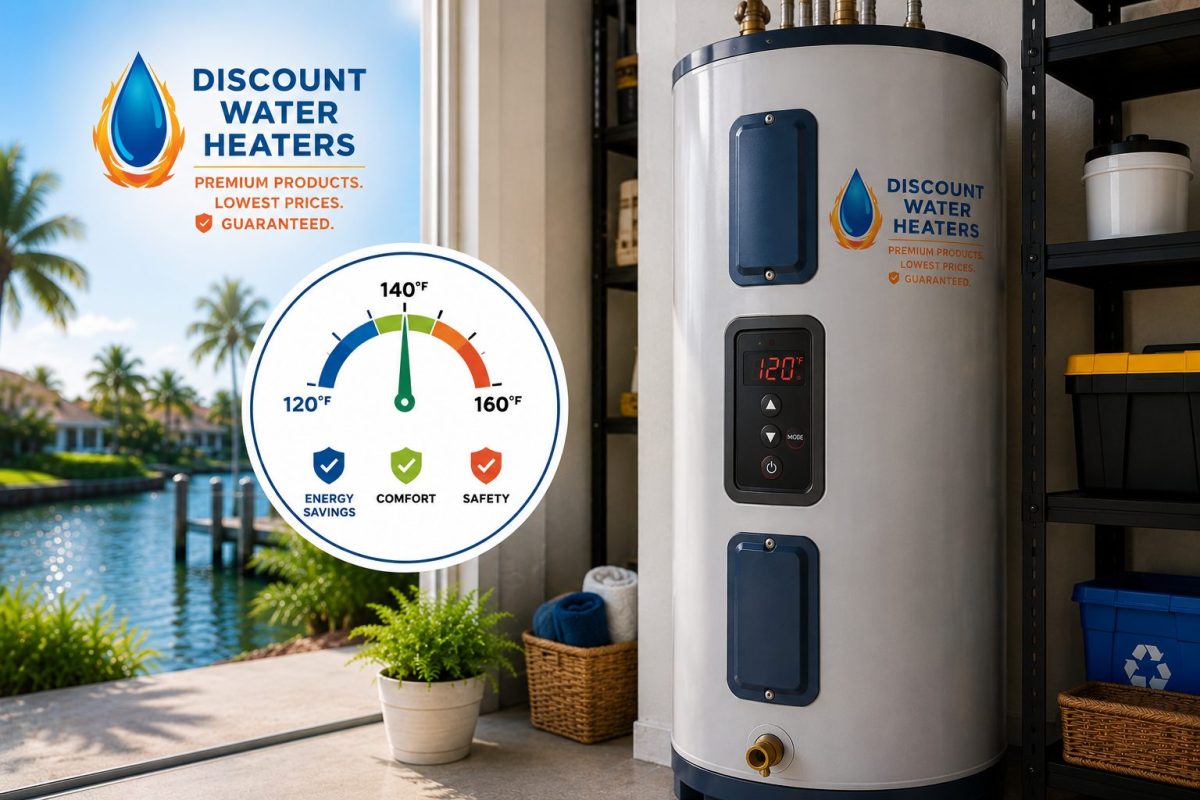
120°F is the sweet spot for most Florida households. The EPA and most plumbing professionals recommend it as the standard setting because it is hot enough for daily use, kills the majority of waterborne bacteria, and reduces the risk of scalding at the tap.
If your water heater came from the factory set at 140°F, that is not dangerous, but it is higher than most households need and costs more every month to maintain. If you are curious how much that extra energy cost adds up over the life of a unit, our post on how long water heaters last in Florida puts the full timeline in perspective.
Why Florida Is a Little Different
In colder climates, incoming groundwater runs 40 to 50°F, so the heater works hard to reach 120°F. Florida groundwater runs closer to 70 to 75°F year round. Your heater starts from a warmer baseline, which means the same thermostat setting costs less energy here than it would up north.
It also means bacteria thresholds matter more. Lukewarm tanks are breeding grounds for Legionella bacteria. If your household includes elderly adults, young children, or anyone immunocompromised, staying at or above 120°F is important. Some medical professionals recommend 140°F for higher risk households with a mixing valve installed at the tap to prevent scalding.
Florida’s hard water is another factor. Mineral buildup accelerates at higher temperatures, meaning tanks set at 140°F accumulate sediment faster. If you haven’t flushed your tank recently, read our step-by-step flush guide before raising the temperature.
How to Check and Adjust Your Temperature
For most tank water heaters the thermostat sits behind the access panel on the side of the unit. Electric heaters typically have two panels, one for the upper element and one for the lower, and both thermostats should be set to the same temperature.
Gas heaters usually have a dial directly on the gas control valve near the bottom of the tank, marked with settings like HOT, WARM, or a numeric range. If you have a gas unit and the pilot went out recently, check our pilot light guide before adjusting the thermostat.
To get an accurate reading rather than guessing from the dial, run the hot water at a tap for two to three minutes and measure it with a kitchen thermometer. That gives you a real number rather than whatever the factory set the dial to.
Settings to Avoid
Anything below 110°F creates ideal conditions for bacterial growth inside the tank and will not be hot enough for dishwashers that rely on the heater rather than an internal heating element.
Anything above 140°F increases your energy bill, accelerates sediment buildup, raises the risk of scalding injuries, and puts additional stress on the tank lining and fittings over time. Keeping sediment in check is one of the five tasks in our ultimate water heater maintenance guide.
The VACATION setting is fine for short trips but do not leave it there long term. Tanks sitting at very low temperatures for weeks are more susceptible to bacterial growth and sediment hardening at the bottom.
If Adjusting the Temperature Does Not Help
If you turn up the thermostat and still run out of hot water quickly, the problem is not your temperature setting. It is likely a failing heating element, heavy sediment buildup reducing tank capacity, or a unit undersized for your household. Check the 7 signs your water heater is about to fail to see if your unit is past the point of adjustment.
If it is time for a replacement, Discount Water Heaters offers same-day installation across Port St. Lucie and the surrounding Treasure Coast. Every tech is vetted through The Blue Collar Recruiter.
Get your free quote today → or call or text (772) 202-6671
Related resources: Learn more about water heater maintenance, water heater repair, how long water heaters last.
Turning your tank down to 120°F trims one line on your power bill. If cooling is the bigger number, our sister company One Hour Heating & Air Conditioning handles Treasure Coast AC tune-ups.
Related Resources for Florida Homeowners: What’s the Right Water Heater Temperature? | Five Hidden Ways Your Water Heater Could Be Wasting Money