
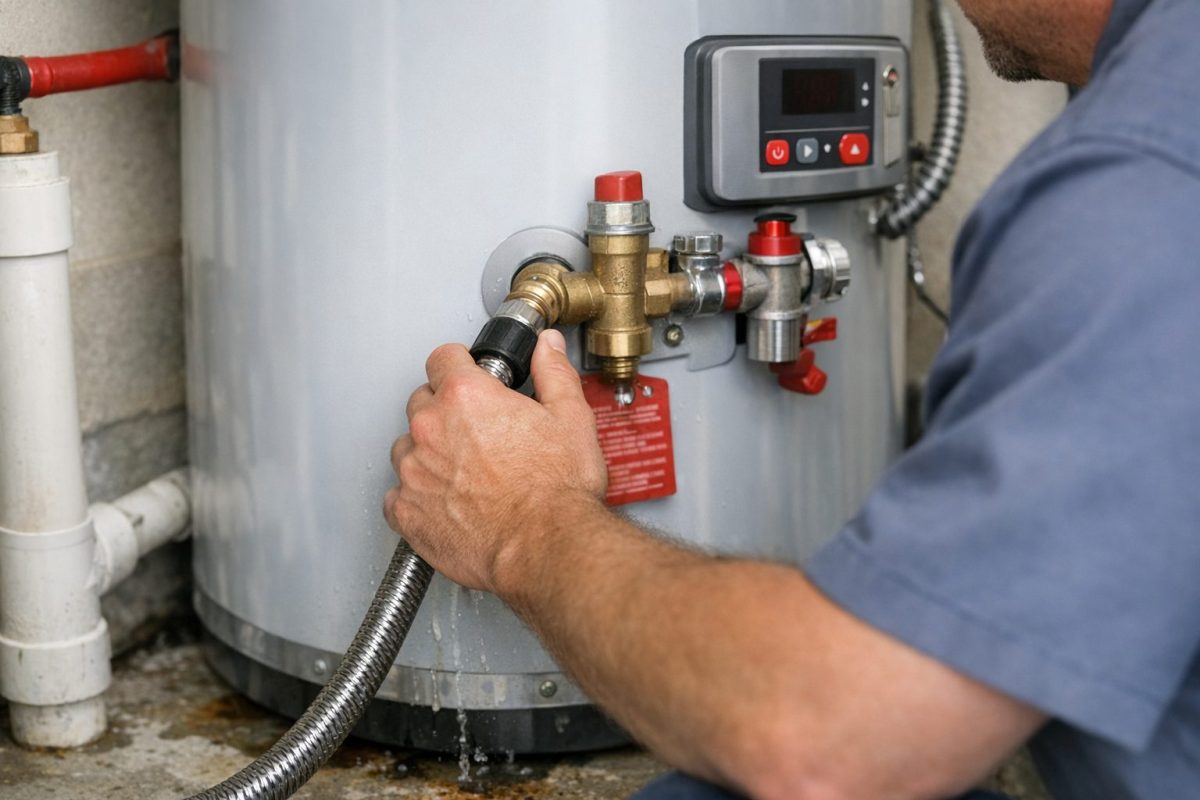
The Hidden Costs of Cheap Water Heaters
You’re standing in front of a water heater that’s stopped working. The utility room floor is dry for now, but you know you’re minutes away from a flooded closet or a bill for damage. You grab your phone, search for water heater prices, and the first listing shows a unit for $300 less than the one next to it. The temptation is immediate: buy the cheaper one, get it installed, move on. But that sticker price you’re looking at isn’t the actual cost of ownership. It’s the first payment on a much larger bill that unfolds over years of operation, repairs, and eventual replacement.
If you’re a Florida homeowner on the Treasure Coast facing an urgent water heater failure, or managing rental properties where unit failures disrupt operations and tenant satisfaction, understanding true ownership cost changes how you evaluate your options. Budget water heaters attract buyers by hiding the real expense in plain sight: they look cheap upfront because manufacturers have cut corners somewhere, and those corners emerge as higher utility bills, frequent repairs, shortened lifespan, and limited warranty coverage that leaves you exposed when something fails.
In our experience evaluating hundreds of water heater replacements for property managers and homeowners across coastal Florida, a consistent pattern emerges: the financial advantage swings decisively away from the budget option once you calculate total ownership cost. What appears to save money upfront routinely costs hundreds more over the unit’s lifetime.
Why That Low Price Tag Is Rarely the Whole Story
A cheap water heater costs less because its manufacturer chose to reduce expense somewhere in the design and manufacturing process. That reduction might be in the quality of the heating element, the thickness of the tank walls, the grade of the anode rod, or the durability of the control valve. None of these decisions make the unit cheaper to operate, they make it cheaper to build. The cost savings shift from the manufacturer’s balance sheet to yours, spread across monthly energy bills, service calls, replacement parts, and eventually a premature unit swap.
The purchase price itself typically accounts for only 20 to 30 percent of what you’ll actually spend on a water heater over its operational life. Installation costs are largely fixed regardless of unit quality. Energy consumption, maintenance, repairs, and the cost of eventual replacement make up the remainder. A homeowner who focuses only on the shelf price and ignores total cost of ownership is making a decision based on incomplete information, exactly the position that leads to regret when repair bills start arriving or utility costs creep higher than expected.
The Real Arithmetic of Ownership Over Time
Total cost of ownership includes the purchase price, installation labor, the energy required to operate the unit, parts and service calls for repairs, and the replacement cost when the unit finally fails. These costs accumulate in different ways and across different timeframes, which is why the true number surprises people who haven’t thought systematically about it.
Consider a comparison between two households installing 50-gallon units. One homeowner chose a budget-tier water heater priced at $400, installed for a total of $600 including labor. The other chose a mid-range unit at $700, installed for a total of $900. The difference at purchase is $300. Over the next eight years, the budget unit required two service calls for heating element replacement ($180 each in parts and labor), ran at lower efficiency so utility costs were $8 to $12 higher per month, and finally failed at year seven, necessitating a full replacement. The mid-range unit required one routine maintenance visit, operated more efficiently, and ran reliably to year nine. By the time both households had hot water again, the “savings” from the cheap unit had evaporated, and the mid-range choice looked financially prudent in retrospect.
Your actual costs depend on your usage patterns, local utility rates, and the specific units you’re evaluating. But the principle holds: the purchase price is the smallest piece of the ownership equation.
Energy Efficiency and What It Means for Your Monthly Bills
Budget water heaters typically carry lower efficiency ratings, measured as Energy Factor (EF) for traditional tank units or Uniform Energy Factor (UEF) for newer models. A lower rating means the cheap water heater uses more energy to heat the same amount of water. Over months and years, that inefficiency compounds into real dollars on your utility bill.
The difference between a unit rated at 0.58 EF and one rated at 0.70 EF isn’t visibly dramatic on a single month’s bill, but spread across 12 months and multiple years, it adds meaningful expense. A household using an above-average amount of hot water, which is typical for Florida homes with larger families or frequent showers, feels this difference more acutely than a low-usage household.
Mid-range models frequently meet or exceed ENERGY STAR standards, which serve as an objective threshold for efficiency. These units recover heat faster, a metric called first-hour rating, which means they’re more responsive to demand and waste less energy reheating water that’s cooled between uses. For a family of four or a multi-unit rental property, that difference in recovery rate affects both comfort and cost.
Repair Frequency and the Cost of Parts You’ll Need
Budget water heaters often use lower-grade components that degrade faster under normal residential use in Florida’s climate. The heating elements are thinner, the anodes corrode more quickly in hard water, and the dip tubes that direct cold water into the tank are made from cheaper plastic that fails prematurely. When one of these parts breaks, you’re calling a technician.
Here’s where quality divergence becomes expensive: when a heating element fails in a mid-range unit, the part is widely available, easy to source, and compatible with standard third-party components. When the same failure occurs in a lesser-known budget brand, the technician may spend extra diagnostic time tracking down the exact replacement part or determining if aftermarket components will work safely. That diagnostic labor, often a $100 to $150 per-call cost, adds up quickly. Some budget brands have such limited parts availability that a repair that would take 45 minutes on a standard unit stretches to two hours, and you’re charged accordingly.
Beyond parts cost, budget units tend to have inconsistent build quality, which means a technician can’t rely on standard troubleshooting procedures. They’re spending time problem-solving rather than implementing a known fix. That time shows up on your invoice as labor.
Warranty Coverage and What Gaps Actually Cost You
Warranty differences between price tiers are substantial, and they directly impact your financial exposure when something goes wrong. A cheap water heater might carry a six-year limited warranty on the tank and one year on parts. A mid-range unit often includes a full ten-year warranty on the tank and five years on components. That gap isn’t just paperwork, it’s the difference between being protected if a catastrophic failure occurs at year six versus being entirely out-of-pocket.
Many budget warranties also include fine print that excludes coverage for hard water damage, mineral buildup, or installation-related issues. In Florida, where hard water is common and mineral accumulation accelerates sediment buildup inside tanks, these exclusions are particularly relevant. You might read your warranty and believe you’re covered, only to file a claim and discover that the specific failure you experienced falls under an exclusion.
A mid-range warranty typically covers these scenarios without the same exclusionary language, and the peace of mind alone justifies the upfront investment. More importantly, if a covered failure occurs, you’re not absorbing the full replacement cost yourself.
Replacement Timelines and the Hidden Cost of Early Failure
A budget water heater might last six to seven years under normal use. A mid-range unit often reaches nine to eleven years. The difference is roughly three to four years of additional service life, which means if you own your home for a decade or longer, you’ll install the cheap unit twice and the mid-range unit once. You’ll absorb the installation labor cost twice, deal with the disruption of a second failure, and face the uncertainty of whether your “new” budget unit will perform better than the first one.
Early failure also comes with hidden operational costs. A unit that fails prematurely often does so without warning, a weekend, a weeknight, or while you’re managing other home issues. Emergency replacement service commands premium pricing and scheduling challenges. Property managers face the additional burden of tenant communication, potential complaints, and operational disruption that extends beyond the simple cost of the unit and installation.
With a mid-range unit, you gain predictability. You know roughly when the unit will need replacement, you can plan for it financially, and you avoid the scenario where a cheap purchase leads to an expensive emergency.
The Case for Mid-Range Quality as the Financially Sound Choice
When you calculate the total cost of ownership across the lifespan of a water heater, including purchase, installation, energy use, repairs, warranty protection, and replacement timing, the cheaper unit almost never wins. The math is straightforward: spending $300 more upfront to avoid $400 to $600 in repairs, higher utility costs, and a premature replacement is a trade-off that makes economic sense.
Mid-range units represent the financial sweet spot. They’re built with components that withstand Florida’s hard water and humidity. Their efficiency ratings are competitive without premium pricing. Warranty coverage is genuine and rarely disputed. Repairs are predictable, parts are available, and the unit operates reliably long enough to justify the investment. You’re not paying for brand prestige or luxury features, you’re paying for durability and consistency.
Property managers and landlords benefit especially from this tier because predictability compounds across multiple units. A mid-range unit installed in five rental properties means five consistent warranty terms, five similar replacement timelines, and lower overall variance in maintenance costs. A budget unit in each property means five different failure patterns, five separate emergency calls, and five separate replacement conversations with tenants.
Start by comparing the total cost of ownership across the units you’re considering, not just the purchase price. Factor in the energy efficiency rating, warranty coverage, expected lifespan, and typical repair costs for each model. Request water heater installation pricing from 2-3 local contractors and ask specifically about warranty coverage and average repair costs for the units you’re comparing. This comparison takes 20 minutes and will clarify why the cheaper unit costs more over time. Once you have the numbers, you’ll see clearly why a mid-range water heater delivers better value than the cheap alternative.
Beyond your water heater, keeping your home comfortable in Florida means maintaining your HVAC system too. If you need reliable AC or heating service on the Treasure Coast, One Hour Heating & Air Conditioning of Treasure Coast is available 24/7 for emergency and scheduled HVAC service.